Marinas and ocean observation: lessons from Land-Sea 2026
Scientists, policymakers, research infrastructures and data platforms gathered recently in the Institute of Natural Sciences in Brussels for Land-Sea 2026, the mid-term conference of the Horizon Europe LandSeaLot project. Weaving through the towering skeletons of creatures whose world was transformed by environmental change, delegates spent the day sharing insights from their work, agreeing on some of the desired impacts of the project and discussing how better-integrated observation and modelling can support policy and wider action.
Under the theme “Shaping an observation strategy together”, the conference took stock of LandSeaLot’s progress and invited participants to help build a Common Observation Strategy for the land-sea interface, where coasts, estuaries and transitional waters meet. Speakers ranged from practitioners in LandSeaLot’s regional Integration Labs to guests from the European Commission (DG Mare and DG RTD), the European Space Agency, EMODnet, the Copernicus Marine Service, EuroGOOS, OSPAR and HELCOM. For TransEurope Marinas, this was a landmark opportunity to show that marinas can contribute to that conversation.
Marinas as observers
TransEurope Marinas joined the morning panel on new solutions for observing the land-sea interface, which explored citizen science, cost-effective technologies and new data flows to EMODnet. As fixed infrastructure bridging land and sea, with communities of boaters, divers and paddleboarders who know their local waters, marinas hold significant potential as contributors to ocean science. They are intrinsically invested in the health of their local waters, and in the long-term resilience of their coastlines and their own infrastructure. Yet our work also revealed a surprising gap in basic understanding of marine ecosystems among some boaters, a reminder of why ocean literacy matters. With the best will in the world, if gathering observations isn’t meaningful and accessible, it simply won’t happen.
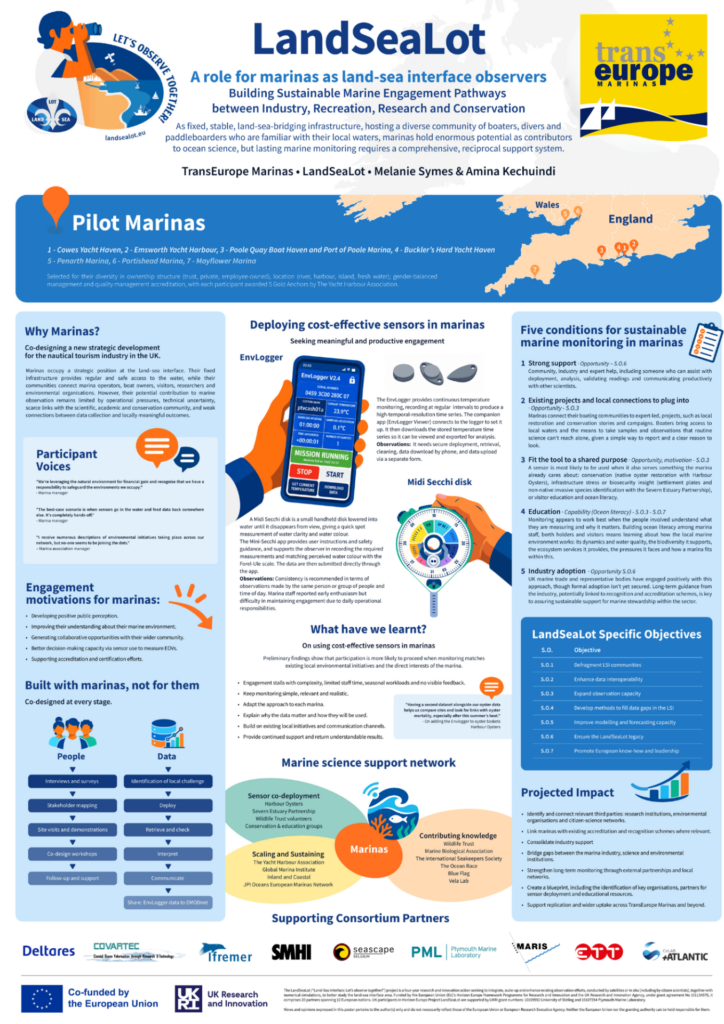
Our poster, A Role for Marinas as Land-Sea Interface Observers, showed this in practice. Seven pilot marinas in England and Wales have been testing simple sensors: an EnvLogger that records water temperature, and a Midi Secchi disk that measures water clarity. Stakeholder discussions have revealed that engagement stalls with complexity, limited staff time and no visible feedback, and works best currently when efforts are related to existing environmental initiatives in the marina. From this, we identified five conditions for sustainable observation: strong support, existing projects to connect with, a shared purpose, education, and industry adoption.
What we learnt
A recurring message was that Europe already has many observation projects and platforms, but they are fragmented, using different methods and governance systems. A common strategy does not mean everyone using the same tools, but better connections, clearer roles, stronger cooperation and, where possible, harmonised and standardised data, so that observations collected in different ways can be compared and combined.
On data, EMODnet’s role is less to produce new observations than to bring data together and make them accessible, with clear information on how, where and when they were collected. Scaling up collection also means scaling up the people and funding to process it. Speakers also stressed combining in situ measurements, satellite data, modelling and citizen science, which is exactly LandSeaLot’s approach.
For marinas, a question around environmental certification or labelling struck a chord – these processes can sometimes indicate what a marina should achieve or improve, but not always how. It echoed our own experience: marinas don’t just need tools and encouragement, but structure, guidance and resources. In short, a roadmap.
Why this matters now
Ocean observation is rising fast up the European agenda. OceanEye, a key element of the 2025 European Ocean Pact, was announced by Commission President Ursula von der Leyen in March 2026 and formally adopted on 3 June, with the aim of a fully operational European ocean observation system by 2030.
Presenting the policy context, Zoi Konstantinou, Policy Officer for Marine Knowledge at DG MARE, outlined the four strands of OceanEye: first, EU governance to support a European Ocean Observing System, to be established through the forthcoming Ocean Act; second, an international dimension; following this, an operational and industrial dimension and finally, strategic partnerships, education and skills, culture and societal ownership. Access to finance and investment runs across all four.
The final strand is of particular relevance to marinas, which serve as a natural point of contact between coastal communities and the sea, and whose users are well placed to observe change in local waters over time
Delegates’ own priorities pointed the same way. When asked which policy areas would most benefit from better land-sea observation, they cited coastal resilience, pollution and the Water Framework Directive at the top, all areas where marinas have a direct stake.
Being part of LandSeaLot brings marinas into the discussion on how Europe observes its coasts and is helping the sector learn how marinas can develop within their communities as proactively contributing to ocean science and improving their understanding of local waters.
A word from Jos Brils, Deltares, LandSeaLot Coordinator
“One of the most inspiring insights from LandSeaLot has been discovering the untapped potential of TransEurope Marinas. I am convinced that marinas can play a unique role in observing the land-sea interface, not only because of where they are located, but because of the people they bring together. Their connection to local waters, curiosity about environmental change and willingness to contribute, make them invaluable partners in building a more connected, inclusive and effective European observation system.”
Looking ahead
With the second half of LandSeaLot now under way, the next step is to use the successes of the pilot marinas to prepare a clear and realistic pathway for marine monitoring, one that can be replicated across our network and beyond, and to convey its importance to industry leaders. The interest is clearly there, but guidance, resources and a supportive community will be key. There are encouraging signs with marinas are increasingly described as located at “the land-sea interface” in industry articles, conferences and social media, and EMODnet is fast becoming a familiar name in the boating world.
Taking part in LandSeaLot thus far has been a wonderful and enormously instructive experience. We would like to thank Seascape Belgium and other LandSeaLot partners for a stimulating day, and our pilot marinas (Emsworth Yacht Harbour, Poole Quay Boat Haven and Port of Poole Marina, Cowes Yacht Haven, Buckler’s Hard Yacht Haven, Mayflower Marina and Penarth Marina) for their enthusiasm and commitment.
If your marina would like to find out more about getting involved, please get in touch.
To learn more about the project, visit https://landsealot.eu/
LandSeaLot has received funding from the European Union’s Horizon Europe Framework Programme for Research and Innovation under grant agreement No 101134575. Views and opinions expressed are however those of the author(s) only and do not necessarily reflect those of the European Union or European Research Executive Agency. Neither the European Union nor the granting authority can be held responsible for them. UK participants in Horizon Europe Project LandSeaLot are supported by UKRI grant numbers: 10109592 University of Stirling and 10107554 Plymouth Marine Laboratory.
Benefits for Boaters TransEurope Marinas
50% Discount on Visitor Berthing
With a 6-month contract at a member marina, receive a 50% discount on daily visitor rates.
Valid Across All Member Marinas
Up to five days per year at each member marina, enabling multiple discounted stays.
Smart Solutions
Make the most of a digital membership platform, helpful chartlets and cruising routes.
Benefits for TransEurope Marina Members
Reward Berth-Holders & Attract visitors
Offer your long-term berth-holders exclusive discounts
Become an Environmental Steward
Take part in innovative European ocean conservation projects
Access Peer Expertise
Join a network of experienced marina managers and access specialist training for your staff
